Crunchometer
The challenge
The Crunchometer was a promotional project for a pickle brand. The idea was that the crunch could be heard, measured and taken home. The problem, however, was not the sound of the pickle, which happens in an instant. It was everything around it. At a fair or an event, ambient noise, conversations and music blend with the bite, and the point of the crunch is lost. This circumstance, it should be noted, called for a separate space.
The soundproof booth, therefore, was going to take care of that part. Inside, the consumer had several attempts to bite the pickle and get the best measurement. The goal, mind you, was recreational and promotional, not scientific. It is not a minor detail that the brand was after an experience people could share, not a laboratory report.
The solution
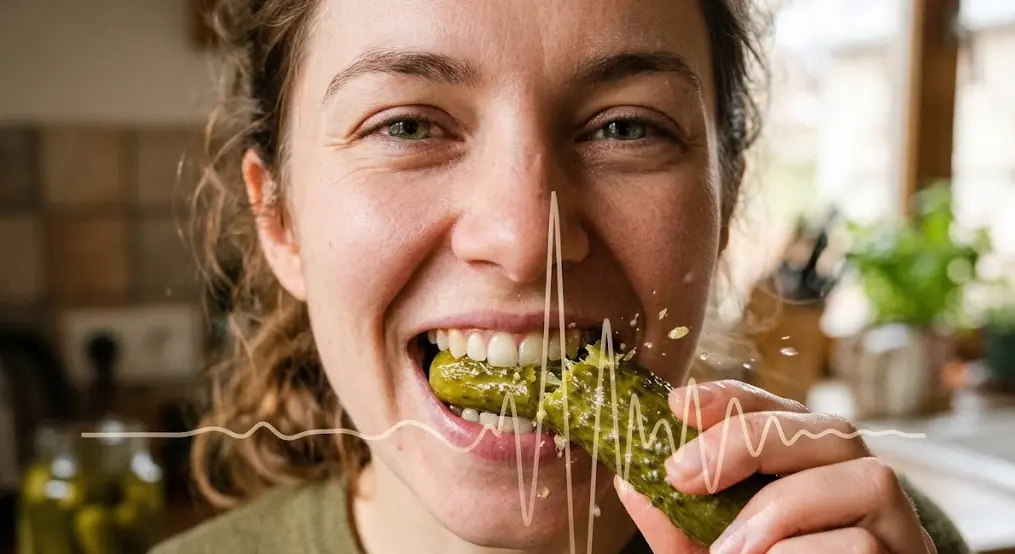
The setup consisted of high-sensitivity microphones, which picked up the sound of the bite, and two cameras, one inside the booth and one outside, the same ones that recorded the action from two angles. At the same time, the booth’s audio channel was mixed into the recording. The screen in front of the user showed a spectrogram, or sonogram, that drew the crunch as it happened.
What the software does is coordinate those signals. The camera, the audio and the spectrogram are recorded together, so the souvenir does not stop at a video, it is a piece with the sound and its visual representation overlaid. When the test ended, the user could enter their contact details and receive the recording later.
The measurements, it has to be said, were indicative. The sound was amplified, the microphones were not specialised, and the dB value was increased with a multiplier. This decision, which may seem questionable, had a logic: to make the difference more visible between a pickle that crunched a lot and one that crunched less. In this context, the number served the visual comparison, not the drawing of conclusions.
The result
The installation did its promotional job. People came in, bit, saw their crunch turned into a graph and took the recording away. The value was in the experience and the memory, which did not depend on the accuracy of the device. The figures remained as a wink, a way of giving weight to a test that was, deep down, a game.